
Summer Basement Mold Prevention: A Complete Guide for DMV Homeowners
In the Washington, DC Metro area, summer is the most dangerous season for basement mold growth. From June through September, outdoor dew points regularly exceed 70°F — conditions classified by meteorologists as “oppressive” — and that moisture-saturated air infiltrates unprotected basements continuously. Without active moisture management, a typical unfinished DMV basement can maintain surface humidity levels above 80% throughout the summer, sustaining continuous mold growth on wood, paper-faced insulation, stored cardboard, and any other organic material present.
Understanding the Summer Moisture Cycle
The summer mold problem in DMV basements is driven by a physics mechanism called vapor diffusion. Warm outdoor air holds significantly more moisture than cool indoor air. When humid summer air infiltrates a cooler basement — through window gaps, foundation cracks, door seals, and the porous concrete/block wall itself — it cools rapidly and deposits its moisture content on cold surfaces. Unlike spring moisture, which is primarily driven by groundwater, summer basement moisture is largely atmospheric: it comes in through the air, not through the foundation.
This distinction matters enormously for prevention strategy. The EPA moisture control guidelines emphasize that summer basement moisture cannot be addressed by waterproofing alone — it requires active dehumidification to maintain safe indoor relative humidity levels throughout the season.
The Five Pillars of Summer Basement Mold Prevention
1. Active Dehumidification
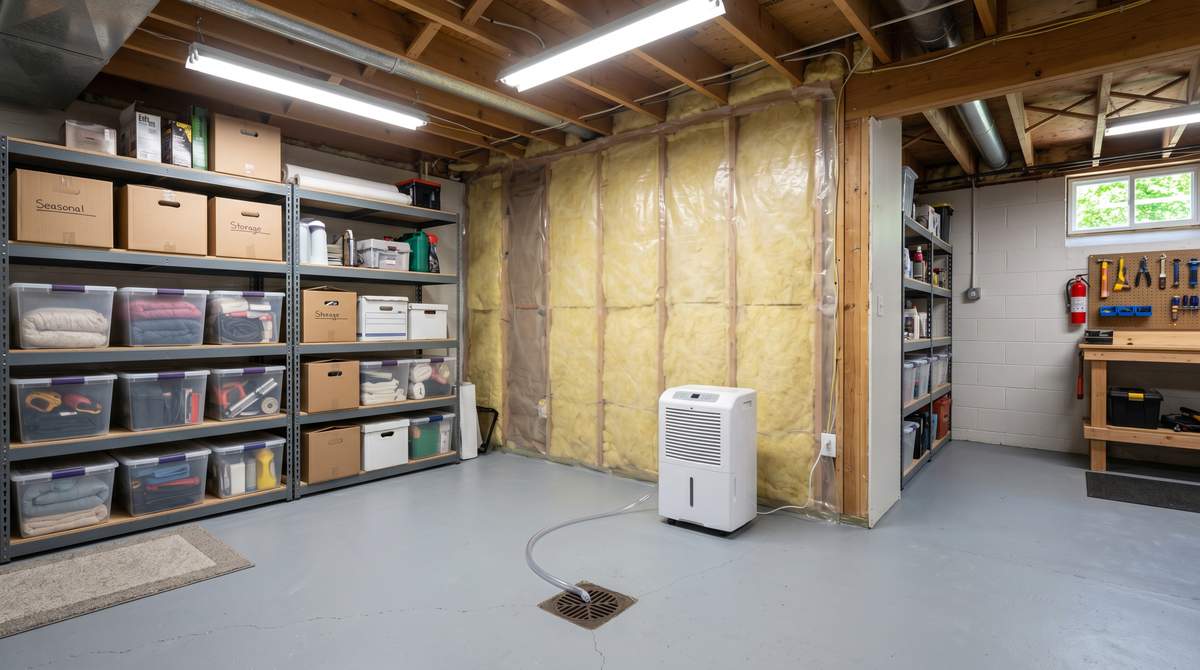
A properly sized Energy Star-certified whole-home dehumidifier is the single most effective summer mold prevention tool for DMV basements. Portable units work for smaller spaces (under 1,500 square feet), but whole-home units plumbed to a floor drain are far more reliable for continuous operation. Target a basement RH of 45% to 55% throughout summer. Understand the relationship between humidity and mold growth to calibrate your control strategy effectively.
2. Source Control: Seal Air Infiltration Points
Every gap between conditioned and unconditioned space is a summer moisture entry point. Common infiltration paths in DMV basements include: rim joist gaps between the foundation wall and floor framing, gaps around pipe and wire penetrations through foundation walls, poorly sealed basement windows, and gaps under basement exterior doors. Sealing these with spray foam or caulk significantly reduces the volume of humid outdoor air entering the basement.
3. Encapsulate Crawl Space Areas
If your home has a partial or full crawl space rather than a basement, summer moisture control requires encapsulation: a continuous polyethylene vapor barrier covering the crawl space floor and walls, sealed at all penetrations. Unencapsulated crawl spaces act as humidity reservoirs that supply moisture to the entire home’s air supply through stack effect. Our mold inspection services in Maryland include crawl space assessment as a standard component of basement inspections.
4. Remove Moisture-Absorbing Organics
Cardboard boxes, paper bags, old newspapers, and natural-fiber area rugs are mold’s preferred growth substrate. Remove all cardboard storage from basements during summer months and replace with plastic bins with locking lids. This single step eliminates the majority of available mold food sources in a typical basement.
5. Monitor with a Hygrometer
A $15 to $30 digital hygrometer provides continuous humidity monitoring and gives you actionable data. Place one at the lowest point of your basement and check it weekly throughout summer. If readings consistently exceed 60%, increase dehumidifier capacity or operating hours immediately.
When Prevention Is Not Enough: Professional Assessment
If you implement all five prevention strategies and still notice musty odors, visible growth, or persistent high humidity readings, it is time for a professional basement mold inspection. There may be concealed growth already established inside wall cavities or under flooring that prevention measures cannot address. Air quality mold testing provides objective data on whether mold spore counts inside your basement are elevated above safe levels, even when visible growth is not apparent.
- Target basement RH: 45%–55% throughout summer months
- Run dehumidifier continuously — not on a timer — during July and August
- Check and empty condensate buckets daily on peak humidity days
- Inspect rim joists and pipe penetrations for air gaps each spring
Frequently Asked Questions
Should I keep basement windows open or closed in summer?
Closed. Opening basement windows in summer introduces warm, humid outdoor air directly into a cool basement space — exactly the opposite of what you want. Keep windows closed and manage humidity actively with a dehumidifier.
How big a dehumidifier do I need for a 1,200 square foot basement?
For a typical 1,200 sq ft DMV basement with moderate humidity, a 50-pint unit is a good starting point. In highly humid conditions or if you’re using it for the whole home, a 70-pint whole-home unit plumbed to a drain is more appropriate and more reliable.
Is mold smell in a basement dangerous even if I cannot see growth?
A musty basement odor is a reliable indicator of active mold growth somewhere in the space. The smell is produced by microbial volatile organic compounds (MVOCs) released by actively growing mold colonies. Schedule a professional inspection to identify the source before growth expands.
Does air conditioning prevent basement mold in summer?
Air conditioning reduces indoor temperatures and relative humidity somewhat, but does not provide sufficient moisture control in basement spaces during DMV summers. A dedicated dehumidifier is necessary in addition to — not instead of — air conditioning.
Need a summer mold assessment for your DMV basement? Call DMV Mold at (301) 379-1715 or schedule via our contact page.