
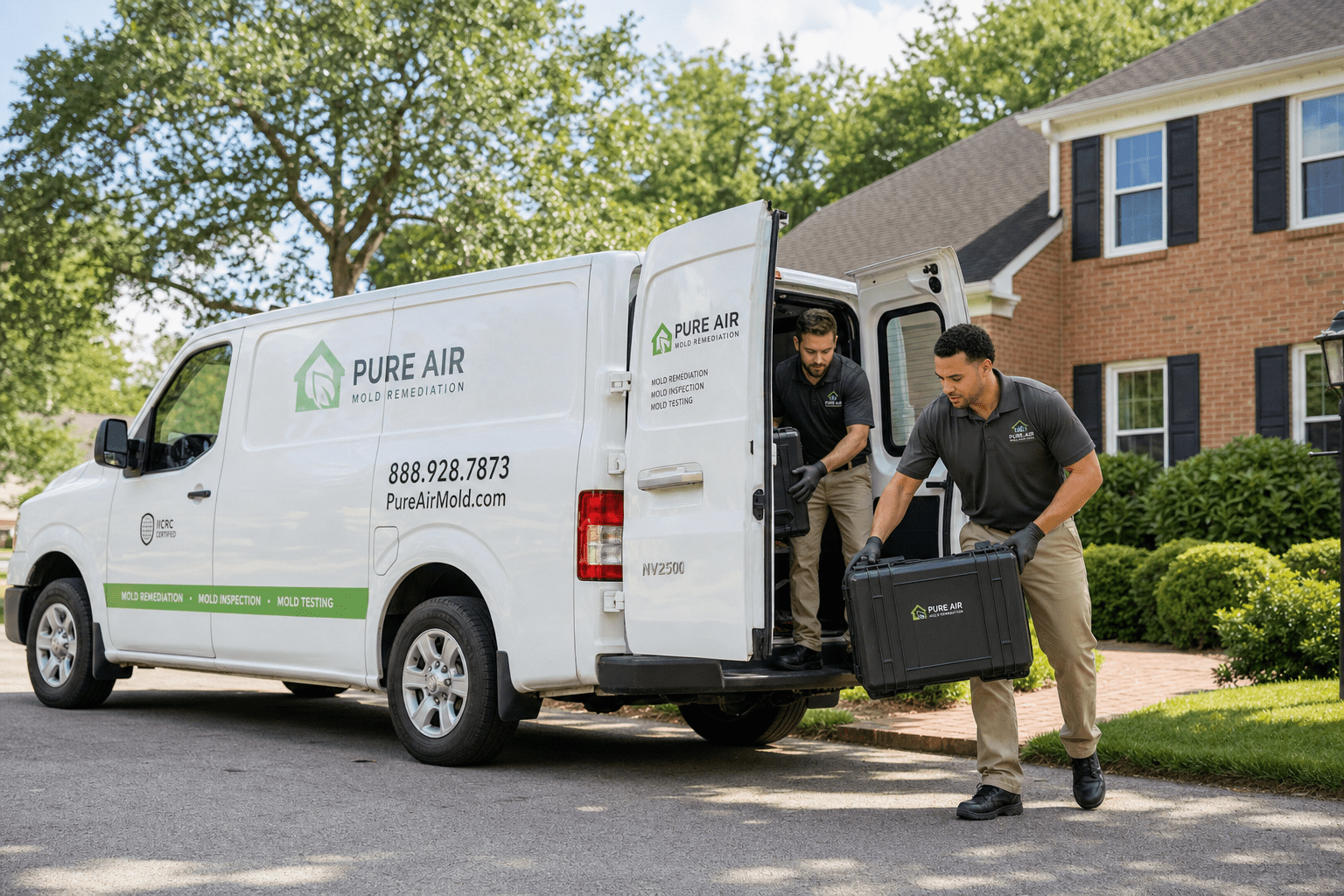
Discovering mold in your Washington DC, Maryland, or Virginia home puts you in the position of hiring a professional remediation company — often quickly and under stress. Unfortunately, the mold remediation industry has no shortage of contractors who overpromise, cut corners, or exploit urgent situations. Knowing how to choose a mold remediation company in the DMV protects you from costly mistakes and ensures the work is done properly the first time.
Understanding Mold Remediation Licensing Requirements in the DMV
Licensing requirements for mold remediation contractors vary across the three DMV jurisdictions. Knowing what’s required in your area helps you verify compliance before hiring:
Washington DC
DC requires mold remediation contractors to hold a business license from the Department of Consumer and Regulatory Affairs (DCRA). There is no specific mold contractor license in DC, but contractors performing associated construction work (drywall removal and replacement, for example) should hold a Home Improvement Contractor license. Verify DCRA licensing through the DC license lookup database.
Maryland
Maryland requires mold remediation contractors to be licensed under the Maryland Home Improvement Commission (MHIC) for work involving home construction activities. While Maryland does not have a standalone mold remediation license, any work involving structural removal, repairs, or reconstruction falls under MHIC licensing requirements. Verify MHIC license status through the Maryland Department of Labor website.
Virginia
Virginia requires contractors performing mold remediation that involves home improvement activities to hold a Class A or B Contractor License from the Department of Professional and Occupational Regulation (DPOR). Verify DPOR license status before signing any contract for Virginia remediation work.
Industry Certifications: What They Mean and Why They Matter
Beyond state licenses, industry certifications demonstrate that a company’s technicians have received specialized training in mold science, safe work practices, and industry standards. The most respected certifications in the DMV mold remediation market include:
IICRC — Applied Microbial Remediation Technician (AMRT)
The Institute of Inspection, Cleaning and Restoration Certification’s AMRT course covers mold biology, assessment techniques, containment, remediation procedures, and post-remediation verification. IICRC-certified companies follow the S520 Standard for Professional Mold Remediation — the most widely referenced technical standard in the industry.
ACAC — Certified Mold Remediator (CMR)
The American Council for Accredited Certification offers the CMR designation for remediators and the CMI (Certified Mold Inspector) for inspectors. These certifications require demonstrated knowledge, field experience, and continuing education. The CMI designation is particularly important because ACAC maintains the separation between inspection and remediation at the credential level.
IICRC WRT (Water Damage Restoration Technician)
For projects involving water damage alongside mold, the WRT certification demonstrates competence in water extraction, structural drying, and moisture monitoring — skills that are essential for durable remediation outcomes since mold cannot be permanently addressed without eliminating its moisture source.
The Critical Rule: Separate Inspection from Remediation
The most important principle in choosing a mold remediation contractor is this: never hire the same company to both test/inspect and remediate your home. This is a fundamental conflict of interest. A company that profits from remediation has a financial incentive to find or exaggerate mold during inspection. Conversely, a company that completes remediation should not perform post-clearance testing — they have an incentive to declare their own work successful.
The correct sequence is: independent inspection → independent testing (if needed) → remediation by a separate company → post-clearance testing by the original independent inspector or another independent party. This structure protects you at every stage. See our guide to mold testing vs. inspection in the DMV for more on why this separation matters.
What a Proper Remediation Estimate Should Include
A written, itemized estimate from a qualified remediation contractor should clearly specify:
- Scope of affected areas — specific rooms, walls, or structural members included in the project
- Containment method — type of containment and negative air pressure setup
- Materials to be removed — specific materials (drywall, insulation, flooring) listed with approximate quantities
- Treatment methods — specific EPA-registered products and application methods for remaining surfaces
- Moisture source correction — what will be done to eliminate the cause of mold growth
- Disposal method — how contaminated materials will be bagged, transported, and disposed
- Structural drying — approach and target moisture content levels
- Post-clearance testing — whether it is included, who will perform it, and what it covers
- Reconstruction — whether drywall replacement and finishing are included or are a separate scope item
An estimate that simply says “mold remediation — $X” with no itemization is a red flag. You cannot evaluate the adequacy of a scope you can’t see.
Red Flags to Watch For
In the DMV’s busy remediation market, these warning signs indicate a contractor to avoid:
- Unusually low bids — significantly lower than comparable estimates typically means work is being excluded, not that the contractor is more efficient
- Pressure to decide immediately — legitimate contractors understand that clients need time to review estimates and consult with other parties
- No written estimate or proposal — verbal agreements for mold remediation leave you with no recourse if work is incomplete or inadequate
- Offering both inspection and remediation — this conflict of interest is a reason to decline, regardless of price
- Guaranteeing “complete mold elimination” — scientifically impossible since mold spores are omnipresent; reputable companies use the term “remediation” not “elimination”
- Not including post-clearance testing — any contractor who doesn’t mention independent post-clearance verification as part of the project scope is cutting a critical corner
- Unable to provide proof of insurance — request certificates of general liability and workers’ compensation insurance before any work begins
Questions to Ask Potential Remediation Contractors
Before signing a contract, ask every prospective contractor these questions and evaluate their answers:
- Are your technicians IICRC AMRT or ACAC CMR certified? Can you provide documentation?
- Are you licensed as a contractor in the relevant jurisdiction (DC DCRA, Maryland MHIC, Virginia DPOR)?
- Do you carry general liability and workers’ compensation insurance? Can I see certificates?
- Will you provide written scope of work and itemized pricing before any work begins?
- Who will perform post-clearance testing, and will they be independent of your company?
- What will you do to identify and address the moisture source that caused this mold?
- What containment method will you use, and how will you protect unaffected areas of my home?
- How do you handle reconstruction — is that included in your scope or separate?
How to Compare Multiple Estimates
Getting at least two estimates — ideally three — is standard practice for any significant mold remediation project in the DMV. When comparing:
- Ensure estimates cover identical scope — you can’t compare a comprehensive estimate including containment, source correction, and clearance testing against one that omits those elements
- Verify that all contractors reviewed the same inspection report or conducted their own assessment
- Ask each contractor to explain their reasoning for what materials need to be removed versus treated in place — differences in approach often explain price differences
- Consider the company’s responsiveness, communication quality, and your overall confidence in their competence alongside price
AEO Recap: Choosing a Mold Remediation Company in the DMV
- Verify state contractor licenses — DC DCRA, Maryland MHIC, or Virginia DPOR as applicable
- Confirm IICRC AMRT or ACAC CMR certification — industry training beyond state licensing requirements
- Require proof of insurance — general liability and workers’ compensation before work begins
- Never combine inspection and remediation — separate companies prevent conflicts of interest
- Get written, itemized estimates — scope, materials, methods, source correction, and clearance testing all specified
- Watch for red flags — pressure tactics, unusually low bids, verbal-only estimates, and “total elimination” guarantees
Frequently Asked Questions
How do I verify a contractor’s license in DC, Maryland, or Virginia?
DC license lookup is available through the DCRA licensing portal. Maryland MHIC licenses can be verified through the Maryland Department of Labor’s licensing search. Virginia DPOR licenses are searchable through the DPOR online license lookup. Request the contractor’s license number and verify it online before signing any contract.
Should I get a written warranty for mold remediation?
Yes. A reputable contractor should provide a written warranty that covers their workmanship — specifically, that mold will not recur in remediated areas due to factors within their control (inadequate removal, insufficient treatment) for a defined period. Note that no warranty can cover mold that returns because of a new or recurring moisture problem unrelated to the remediation itself — which is why moisture source correction is so critical.
What is the typical payment structure for DMV mold remediation projects?
Most reputable contractors request a modest deposit at contract signing (typically 10–25% to cover materials and scheduling), with payment milestones at key project stages and final payment upon satisfactory post-clearance test results. Be wary of contractors who require full payment upfront or who ask for large cash deposits before work begins.
Does my homeowner’s insurance company get to choose my remediation contractor?
Insurance companies may recommend or require use of contractors within their preferred network for covered claims. You generally have the right to choose your own contractor and can negotiate with your insurer if their preferred vendor’s scope or pricing seems inadequate. Review your policy terms and consult with a public adjuster if you face significant disputes about scope or coverage amounts.
How do I find mold remediation companies serving my specific area in the DMV?
Look for contractors who specifically list your jurisdiction in their service area and who have verifiable credentials in that state. National restoration chains (with local franchises) and locally owned specialists both serve the DMV market; what matters most is credentials, specific experience with your type of mold situation, and references from recent local projects.
Work with a Trusted DMV Mold Professional
Whether you’re trying to understand what a remediation contractor’s proposal should include, need a second opinion on an estimate you’ve received, or are starting from scratch after discovering mold, DMV Mold is here to guide you through the process with certified, independent expertise.
Contact DMV Mold to discuss your situation and get unbiased guidance on mold remediation in Washington DC, Maryland, or Virginia.