
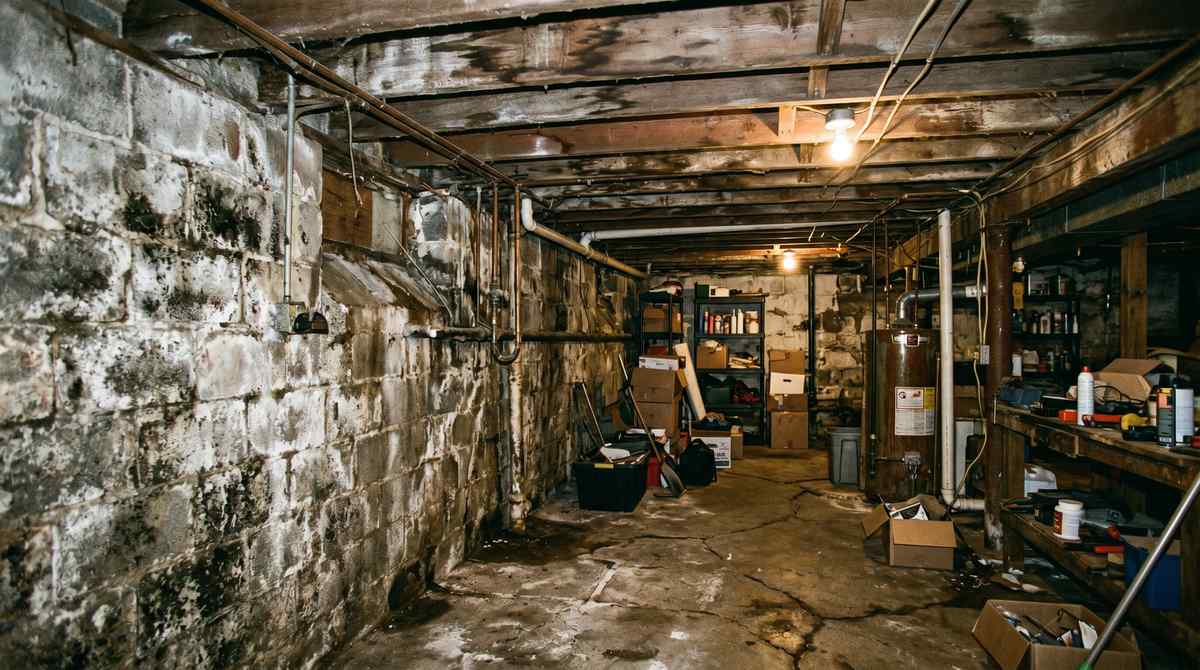
Bethesda Basement Mold: Why Older Homes Are Most at Risk
Bethesda, MD is one of the most desirable communities in the Washington, DC Metro area — and one where a significant proportion of the housing stock dates to the 1940s through 1970s. These homes carry tremendous character and often outstanding build quality for their era, but they also carry a mold liability that newer construction largely avoids: aging waterproofing systems, porous block or stone foundations, and a near-total absence of the moisture management technologies we take for granted in modern construction.
Why Older Bethesda Homes Are Structurally Vulnerable
Homes built before approximately 1980 were typically constructed without interior or exterior drainage membranes, sump pit systems, or interior French drains. Foundation waterproofing — if it existed at all — consisted of a single brush-coat of tar applied to the exterior block surface, which degrades significantly over 20 to 30 years. By the time a home is 40 to 60 years old, that original waterproofing provides essentially no protection against the seasonal groundwater fluctuations that Bethesda’s topography and clay-heavy soil produce. The result is that water finds the path of least resistance directly through the foundation wall into the basement living space.
The relationship between humidity and mold growth is particularly pronounced in these unprotected basement environments. A porous block wall that wicks exterior soil moisture constantly maintains surface RH levels above 80% during summer months — well beyond the 70% threshold at which mold spores germinate rapidly.
The Most Common Mold Locations in Bethesda Basements
Our inspectors providing mold inspection services in Bethesda, MD routinely find mold in predictable locations within older homes:
- Along the base of foundation walls where block meets concrete slab — the classic efflorescence band
- Behind drywall that was installed directly against the foundation wall without an air gap or vapor barrier
- Inside fiberglass batt insulation in stud wall cavities adjacent to the foundation
- Under carpeting and carpet padding laid directly on concrete slab
- Inside wood framing members and OSB sheathing in finished basement ceilings where roof drainage or plumbing leaks have occurred above
The EPA guide on mold in the home emphasizes that mold growing on porous materials like drywall, insulation, and carpet cannot be cleaned — these materials must be removed and replaced as part of any effective remediation strategy.
Recognizing Early Warning Signs
Early identification of basement mold before it spreads to framing members is critical to keeping remediation costs manageable. Warning signs specific to older Bethesda homes include:
- White, chalky efflorescence on block foundation walls — mineral deposits left by evaporating moisture
- Musty odor that concentrates near the stairwell or basement entry
- Rust staining at the base of metal support columns or appliance feet
- Bubbling or peeling paint on block walls
- Any visible dark spotting on drywall, framing lumber, or wood trim
Professional Basement Mold Inspection in Bethesda
A professional basement mold inspection in an older Bethesda home involves significantly more than a quick visual walkthrough. Our inspectors use calibrated moisture meters to map the moisture gradient across foundation walls, thermal imaging to identify concealed wet zones behind finished surfaces, and air sampling to quantify whether mold spores are actively dispersing from hidden growth into the basement air column. If black mold testing is warranted based on visual indicators, surface swab samples are collected and sent to an accredited laboratory for species identification.
- Professional inspection covers foundation walls, slab junction, framing, insulation, and finished surfaces
- Moisture mapping documents the full scope of at-risk zones
- Lab results identify species and spore counts to guide remediation priority
- Written report supports contractor bids and insurance documentation
Frequently Asked Questions
How often should older Bethesda homes have a basement mold inspection?
Homes with known moisture history should be inspected annually, ideally in late spring when groundwater levels and humidity are at their seasonal peak. Homes without prior moisture issues should be inspected every two to three years as a precautionary measure.
Can I finish my basement if mold is present?
No. Covering active mold with new drywall or flooring does not eliminate the problem — it accelerates growth by trapping moisture and organic material in a dark, enclosed space. All mold must be professionally remediated before any finishing work begins.
Is mold in a Bethesda basement a material defect I should disclose in a sale?
Yes. Maryland law requires sellers to disclose known material defects, which typically includes known mold conditions. A pre-sale inspection with a clean report is the most effective way to protect your transaction and your liability.
What is the typical cost to remediate basement mold in Bethesda?
Remediation costs vary significantly based on the extent of growth and materials affected. Surface mold on block walls might cost $500 to $1,500 to treat, while extensive growth behind finished walls involving drywall and insulation removal can range from $3,000 to $15,000 or more.
Concerned about mold in your Bethesda home? Call DMV Mold at (301) 379-1715 or visit our contact page to schedule a professional basement mold inspection.