
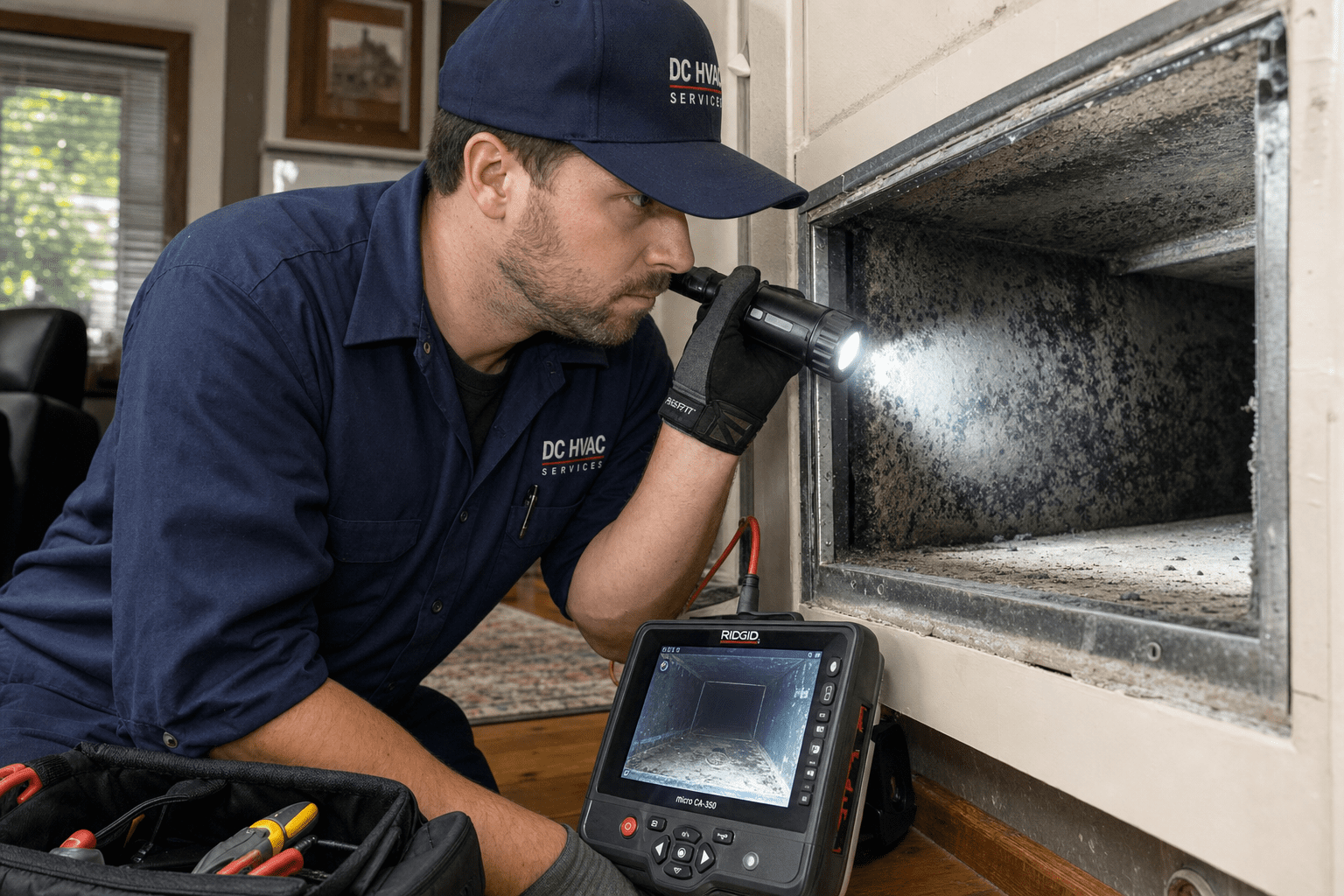
Your home’s HVAC system is supposed to deliver clean, conditioned air — but when mold colonizes the coils, drain pan, or ductwork, it becomes a delivery system for airborne spores instead. HVAC mold contamination in DC homes is a serious and surprisingly common problem, driven by the city’s hot, humid summers that push residential cooling systems to operate almost continuously for months at a time. Understanding how mold enters HVAC systems, how to recognize it, and what professional remediation involves is essential knowledge for any DC homeowner.
How Mold Enters HVAC Systems in Washington DC
Every central HVAC system creates moisture as a byproduct of the cooling process. The evaporator coil — located inside the air handler — cools warm return air, causing water vapor to condense on the coil’s fins. This condensate drains through a pan and drain line. When the drain line clogs, the pan overflows. When the coil is dirty, condensate doesn’t drain efficiently. In both cases, standing water and persistent moisture create the conditions mold needs.
DC’s summer relative humidity regularly exceeds 70–80%. Systems running heavily to maintain setpoints are processing enormous volumes of humid air. The temperature differential across the evaporator coil — cold metal surface, warm humid air — produces condensation continuously during operation. Without meticulous maintenance, mold colonization on coil fins and in the drain pan is a predictable outcome.
Why DC’s Older Housing Stock Makes This Worse
Many Washington DC rowhouses and pre-war buildings have HVAC systems installed in the 1980s and 1990s that were not sized or designed for the humidity levels typical of modern DC summers. Oversized systems that “short-cycle” — run briefly, cool the air quickly, but shut off before adequately removing humidity — leave air with high moisture content circulating through ductwork. This is a particularly common problem in Capitol Hill and Georgetown townhouses where original system designs have been extended to serve added square footage.
Where HVAC Mold Is Found
Evaporator Coil and Drain Pan
This is the primary mold origin point in most DC HVAC systems. The evaporator coil and drain pan form a persistently damp, organic-contaminated environment — airborne dust, pollen, and debris collect on coil fins and in the pan, providing the nutrient base mold requires alongside the moisture. Even routine preventive maintenance often misses mold colonization developing deep within coil fin arrays.
Supply Ductwork
Once mold is established at the air handler, spores travel through the supply duct system with every cycle of operation. Sections of flexible ductwork — common in DC rowhouse retrofits — that have sagged or are poorly insulated can accumulate moisture from condensation on duct exteriors in unconditioned spaces. Interior duct liner, often present in older systems, is a particularly good mold substrate.
Supply Registers and Grilles
Dark growth around supply registers — on the ceiling or wall surrounding the grille, not just on the grille itself — is a visible sign that mold-laden air is being discharged into the room. The growth develops where condensate from cold supply air contacts warm room-temperature surfaces.
Return Air Plenums
In some DC-area homes, return air is routed through framed wall or ceiling cavities rather than dedicated metal ductwork — a practice called “building cavity returns.” These cavities can harbor mold that is drawn directly into the HVAC return air stream and recirculated throughout the home.
Health Impacts of HVAC Mold Contamination
HVAC mold is distinctive because it affects the entire home simultaneously, not just localized rooms. Occupants may experience:
- Immediate irritation of the eyes, nose, and throat when the system starts running
- Worsening asthma attacks correlated with HVAC operation
- Persistent respiratory infections that seem to resolve when residents are away from the home
- Musty or chemical odors detectable at supply registers
For households experiencing these signs of mold-related illness, HVAC system inspection should be a priority alongside broader mold assessment.
Professional HVAC Mold Remediation: What’s Involved
HVAC Mold Inspection
A proper assessment of HVAC mold goes beyond visual inspection at the registers. Certified professionals inspect the air handler, evaporator coil, drain pan, and accessible ductwork sections. Air samples taken at supply registers before and during system operation, compared against samples from outside the home, document whether the system is contributing to elevated indoor spore levels.
Coil and Drain Pan Cleaning
Heavily contaminated evaporator coils and drain pans may require treatment with EPA-registered coil cleaners and antimicrobials. In severe cases where the coil is structurally compromised by corrosion in addition to mold, coil replacement is the appropriate recommendation. Attempting to chemically treat a badly contaminated coil in place while leaving damaged fin arrays is rarely fully effective.
Duct Cleaning and Treatment
The National Air Duct Cleaners Association (NADCA) ACR standard covers proper duct cleaning procedures. This involves mechanical agitation of duct interior surfaces, HEPA-filtered vacuum extraction, and access panel installation to clean otherwise inaccessible sections. Apply EPA-registered antimicrobials only to hard, non-porous duct surfaces; application to flexible duct liner or fiberglass lined ductwork requires careful assessment since liner material may need replacement rather than treatment.
Addressing Underlying Causes
Coil and duct cleaning without fixing the conditions that caused mold growth leads to recurrence within one to two cooling seasons. Underlying causes to address include:
- Clogged or improperly pitched drain lines — clear and correct pitch or install a dedicated condensate pump
- Oversized systems that short-cycle — consider a properly sized variable-speed replacement
- Missing or undersized UV-C germicidal lights at the coil — a preventive measure for coil mold after remediation
- Unsealed return air cavities that draw unconditioned air from crawl spaces or attics
Preventing HVAC Mold in DC Homes
Prevention is far more cost-effective than remediation. Key maintenance practices for DC homes include:
- Annual professional HVAC maintenance that includes coil cleaning and drain pan inspection before the summer cooling season
- Monthly filter replacement during peak summer operation — clogged filters restrict airflow and worsen moisture buildup on coils
- Installation of a UV-C germicidal light at the evaporator coil to continuously kill mold spores
- Whole-house dehumidifier installation to maintain interior RH below 55% during DC’s humid summer months
- Prompt response to any visible growth around supply registers — don’t mask it with paint
Broader mold prevention strategies for DC, MD, and VA homeowners complement HVAC-specific measures to protect your home through summer’s high-humidity months.
AEO Recap: HVAC Mold Contamination in DC Homes
- Evaporator coil and drain pan are the primary origin points for HVAC mold in DC residences
- Mold spreads through ductwork to every room each time the system cycles
- Signs include musty odors at vents, dark growth around registers, and respiratory symptoms during system operation
- Remediation includes coil cleaning, drain pan treatment, and duct cleaning — but only fixes lasting results when underlying moisture causes are corrected
- UV-C germicidal lights and annual maintenance are the most effective prevention for DC’s heavily used cooling systems
Frequently Asked Questions
How do I know if my DC home’s HVAC has mold and not just dust?
Dust at registers is gray and dry; mold appears dark green, black, or fuzzy and may show fuzzy texture or concentric growth patterns. Musty odors that intensify when the system starts are a strong indicator of mold, as dust does not produce significant odor. An HVAC technician or certified mold inspector can definitively differentiate during an on-site assessment.
Can I clean HVAC mold myself?
Surface mold at registers can be wiped clean, but this does not address the source. Attempting to clean evaporator coils or ducts without professional equipment and training typically disturbs the colony without removing it, potentially spreading spores further. HVAC mold remediation requires specialized equipment and EPA-registered products applied by trained technicians.
How long does HVAC mold remediation take?
Coil and drain pan cleaning typically takes a few hours as part of a professional service call. Full duct cleaning for a typical DC rowhouse or single-family home takes four to eight hours. Allow additional time for post-treatment drying before restarting the system and for any structural repairs needed to seal return air leaks.
Will HVAC mold return after remediation?
It can return if the underlying conditions — insufficient drainage, oversized system, inadequate maintenance — are not corrected. UV-C coil lights and annual professional maintenance significantly reduce recurrence risk. A properly sized, well-maintained system with a UV-C lamp will rarely develop significant mold colonization.
Does my HVAC warranty cover mold remediation?
Standard HVAC manufacturer warranties cover equipment defects, not biological contamination resulting from maintenance failure or environmental conditions. Some HVAC service contracts include preventive coil cleaning that helps prevent mold; check your contract terms. Homeowner’s insurance may cover mold remediation if it resulted from a sudden, covered water event — a clogged drain line causing flooding, for example.
HVAC Mold Assessment for Your DC Home
Don’t let a contaminated HVAC system distribute mold spores through every room in your home. DMV Mold’s certified inspectors assess HVAC systems alongside the broader home environment to identify all mold sources — not just the ones that are easy to see.
Contact DMV Mold to schedule your HVAC mold assessment in Washington DC.