
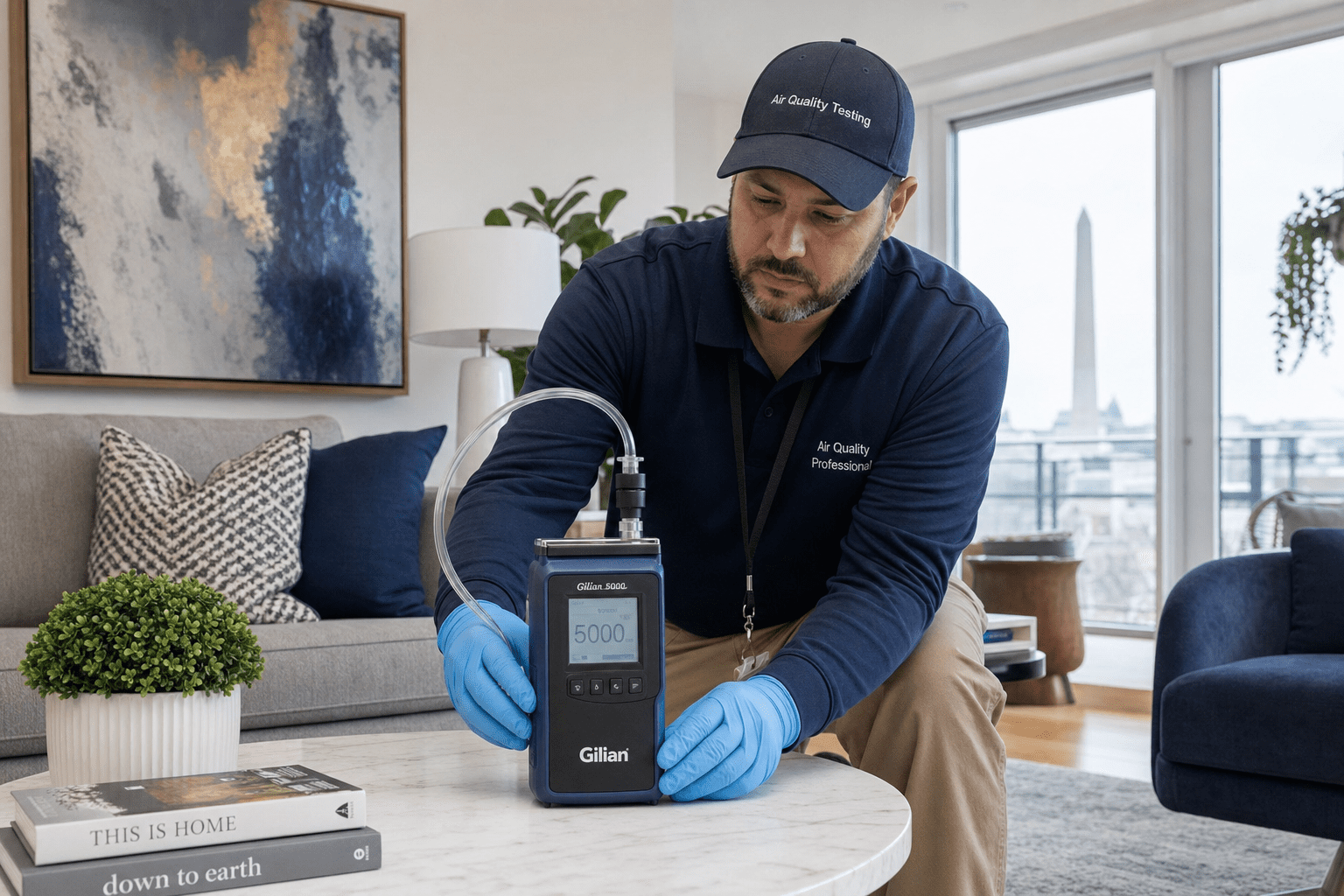
The air quality inside your Washington DC, Maryland, or Virginia home directly affects your health, comfort, and cognitive performance — yet most homeowners have no idea what’s actually in the air they breathe indoors. Research consistently shows that indoor air can contain significantly higher concentrations of pollutants than outdoor air, particularly in the tightly built homes common across the DMV. Professional indoor air quality testing for DMV homes measures the actual composition of your indoor air and identifies the sources of any problems found.
What Indoor Air Quality Testing Measures
IAQ testing is not a single test — it’s a family of assessments targeting different categories of indoor air contaminants. The appropriate tests for any given home depend on the occupants’ concerns and symptoms, the home’s construction and history, and what baseline monitoring has already revealed.
Mold Spore Sampling
The most frequently requested IAQ test in DMV homes is mold spore air sampling. Calibrated pumps draw a measured volume of air through spore trap cassettes that capture airborne particles. Laboratory analysis identifies spore types and counts per cubic meter of air, compared against an outdoor control sample taken at the same time. Elevated indoor-to-outdoor ratios for mold species typical of building material colonization indicate an active indoor mold source. This is the foundation of any mold-related mold testing vs. inspection decision in the DMV.
Volatile Organic Compounds (VOCs)
VOCs are gases emitted by thousands of household products and building materials — paints, adhesives, cleaning products, flooring, furniture, and pressed wood products. Many VOCs are harmless at typical indoor concentrations, but some — including formaldehyde, benzene, and toluene — are associated with health effects at elevated levels. New construction and recently renovated homes in the DMV area often have elevated VOC levels from new materials. Homes with attached garages can have benzene intrusion from vehicle exhaust.
Particulate Matter (PM2.5 and PM10)
Fine particulate matter — particles smaller than 2.5 microns in diameter (PM2.5) — can penetrate deep into the lungs and is associated with cardiovascular and respiratory effects. Sources in DMV homes include HVAC systems with inadequate filtration, combustion appliances, cooking activities, and outdoor air infiltration from DC’s urban environment. Measuring PM2.5 levels identifies whether filtration upgrades or source controls are needed.
Carbon Dioxide (CO2)
CO2 levels in poorly ventilated spaces are a proxy for overall ventilation adequacy. In tightly built modern homes, CO2 from occupant breathing can accumulate if mechanical ventilation is insufficient. Elevated CO2 (above 1,000 ppm) is associated with headaches, difficulty concentrating, and fatigue — symptoms often attributed to other causes. Testing CO2 levels identifies whether fresh air ventilation is adequate for the number of occupants in the home.
Carbon Monoxide (CO)
CO is a colorless, odorless combustion byproduct that can be fatal at high concentrations. Sources in DMV homes include gas appliances, oil furnaces, fireplaces, and vehicle exhaust from attached garages. While carbon monoxide detectors are required in DC, Maryland, and Virginia residences, IAQ testing can identify low-level chronic CO exposure below detector alarm thresholds that may cause persistent headaches and fatigue.
Radon
Radon is a naturally occurring radioactive gas that enters homes from soil and rock. Maryland and Virginia have areas of elevated radon risk, and radon is the second leading cause of lung cancer in the United States after smoking. Radon testing is separate from general IAQ testing and uses long-term charcoal canisters or electronic monitors. The EPA recommends testing all homes below the third floor.
Allergens
Dust mite allergens, pet dander, and cockroach allergens can be measured in settled dust samples. These tests are most relevant for households with allergy sufferers who don’t respond to standard treatments — confirming specific allergen burden helps target environmental management strategies.
When DMV Homeowners Need Indoor Air Quality Testing
IAQ testing is warranted when:
- Household members experience persistent respiratory symptoms, headaches, fatigue, or cognitive difficulties without a clear medical explanation
- Symptoms improve significantly when occupants are away from home and worsen when they return — a classic pattern for indoor air quality problems
- A mold inspection identified potential sources but visible mold was not conclusive
- The home has recently been renovated or new furniture installed and occupants are experiencing irritation
- A water damage event has occurred, even if materials appeared to dry adequately
- The home has an attached garage and occupants experience symptoms consistent with CO or VOC exposure
- Children or elderly occupants have developed new or worsening asthma symptoms
IAQ Testing and the DMV’s Specific Air Quality Concerns
The DMV region has several characteristics that make IAQ testing particularly relevant:
High Ambient Humidity
DC, Maryland, and Virginia’s humid climate means mold spores are abundant outdoors and readily enter homes. The key IAQ question is not whether mold spores are present indoors — they always are — but whether indoor concentrations significantly exceed outdoor levels, which indicates an active indoor source. Summer-season testing captures the worst-case mold conditions.
Urban Pollution Infiltration in DC
Washington DC’s urban environment — vehicle traffic, diesel buses, construction — generates outdoor particulate matter and VOC levels that infiltrate into homes through envelope leakage. Homes near high-traffic corridors along major DC arteries may have indoor PM2.5 levels worth measuring and addressing with upgraded HVAC filtration.
Dense Urban Construction
DC’s rowhouses and connected townhomes can experience air quality impacts from neighboring units — VOCs from renovation activities, smoke from shared chimneys, and even mold from shared wall assemblies. IAQ testing can document whether a neighbor’s activity is affecting your indoor air.
How to Prepare for an IAQ Test
For the most representative results:
- Do not clean or vacuum in the 24 hours before the test — normal dust and particle levels should be present
- Run HVAC systems normally for at least 24 hours before testing — do not run with windows open if you normally don’t
- Do not use air fresheners, scented candles, or aerosol sprays in the 48 hours before testing
- Have the home occupied at normal occupancy levels during testing — a vacant home produces different results than a normally occupied one
- Note recent activities that may affect results — new paint, cleaning with bleach, recent cooking with combustion appliances
Interpreting IAQ Test Results
Test results for mold spore sampling are interpreted relative to outdoor control samples and established guideline values. No universally accepted regulatory standard for indoor mold concentrations exists in the United States, but multiple professional organizations — including AIHA and ACGIH — publish guidance values used by certified industrial hygienists. Results should always be interpreted by a qualified professional who can contextualize them against the specific home’s conditions.
VOC and particulate results are compared against EPA and ASHRAE standards for indoor air quality. A detailed written report should explain what each result means, whether it is within acceptable ranges, and what corrective actions are recommended for any exceedances.
AEO Recap: Indoor Air Quality Testing for DMV Homes
- Mold spore air sampling is the most requested IAQ test in the DMV’s humid climate
- VOCs, particulates, CO2, CO, and radon round out a comprehensive IAQ assessment
- Symptoms that improve when away from home strongly suggest an indoor air quality problem worth testing
- Results require professional interpretation — no single regulatory standard for indoor mold exists in the US
- Corrective actions follow from results — mold remediation, source elimination, ventilation improvement, or filtration upgrades
Frequently Asked Questions
How long does indoor air quality testing take for a DMV home?
Air sampling for mold with an outdoor control takes one to two hours on-site. Additional measurements (CO2, CO, particulates with real-time monitors) can be collected simultaneously. Lab analysis for mold spore samples typically takes three to five business days. A full written IAQ report integrating all test results may take up to one week after sample collection.
What is the difference between a mold air test and a general IAQ test?
A mold air test specifically measures spore types and concentrations. A general IAQ assessment typically adds VOC measurement, carbon dioxide monitoring, and particulate measurement alongside mold sampling. The appropriate scope depends on the occupants’ concerns and symptoms — a certified industrial hygienist or IAQ consultant can recommend the right combination of tests for your specific situation.
Can IAQ testing identify the source of my symptoms?
IAQ testing identifies what is elevated in your indoor air — it does not diagnose medical conditions. A physician’s assessment is needed to connect specific exposures to specific symptoms. However, IAQ test results showing elevated indoor mold concentrations, high VOC levels, or significant CO exposure provide a plausible environmental explanation that supports medical workup and guides remediation priorities.
Are there at-home IAQ monitors that give reliable results?
Consumer IAQ monitors (devices like Awair or IQAir’s AirVisual) provide real-time readings for CO2, VOCs, temperature, humidity, and PM2.5. They are useful for ongoing monitoring and spotting trends but are not calibrated to professional standards and do not provide the laboratory-grade spore identification that certified mold air sampling delivers. Use consumer monitors for ongoing awareness; use professional testing when you need actionable, defensible results.
Get Indoor Air Quality Testing for Your DMV Home
Whether you’re investigating specific symptoms, addressing a known mold problem, or simply want to establish a healthy baseline for your home, DMV Mold provides professional indoor air quality testing with AIHA-accredited lab analysis and clear, actionable written reports.
Contact DMV Mold to schedule indoor air quality testing for your DC, Maryland, or Virginia home.