
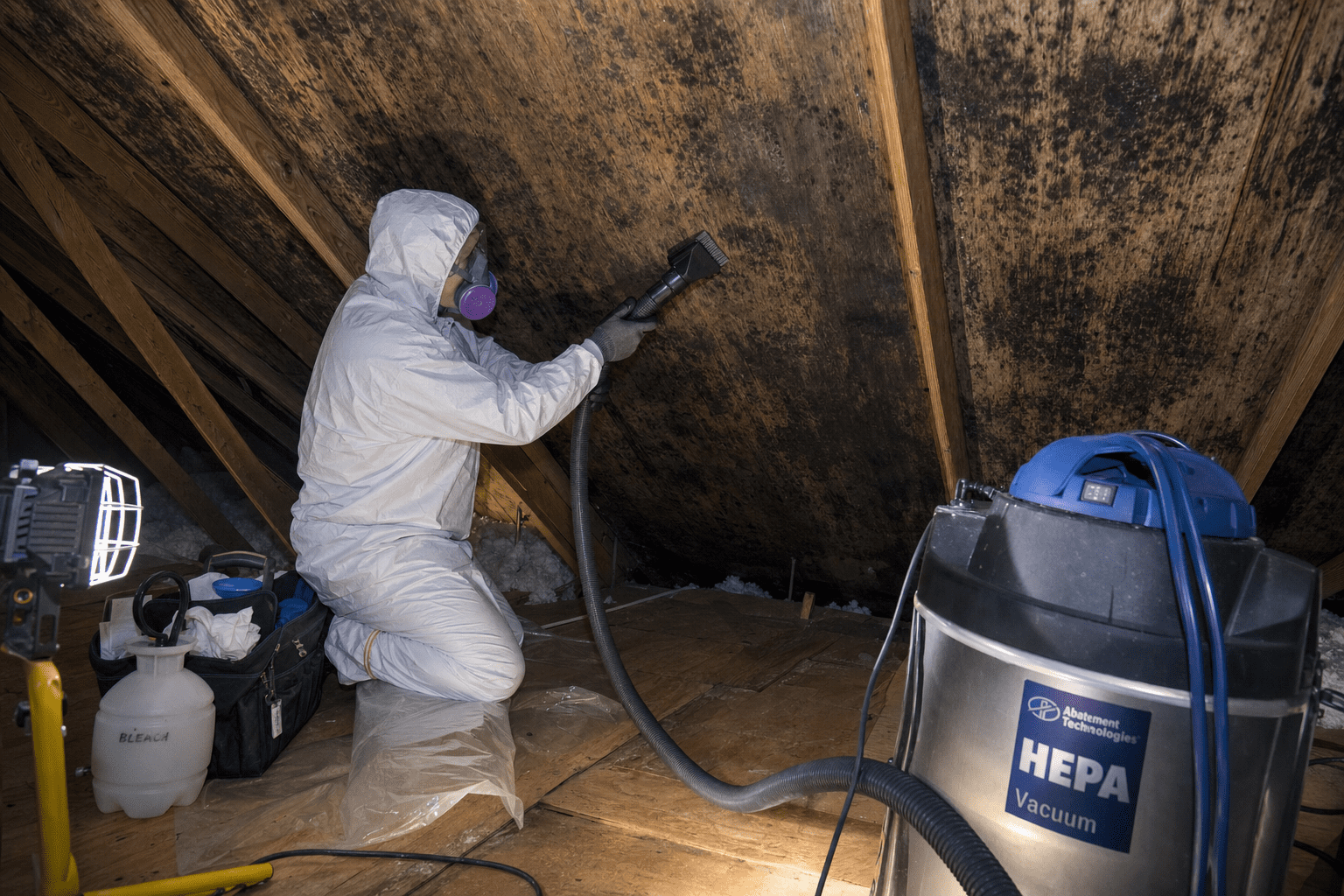
Attic mold is one of the most common yet least noticed mold problems in Maryland homes. Because most homeowners rarely venture into their attic, colonies can grow extensively on roof sheathing, rafters, and ridge boards before a musty smell, roof discoloration, or a home inspection finally brings them to light. Professional attic mold removal in Maryland addresses not just the visible growth but the ventilation and air sealing failures that caused it — without which the mold will return within a season or two.
What Causes Attic Mold in Maryland Homes?
Maryland’s climate — humid continental with hot summers and cold winters — creates seasonal conditions that particularly stress attic moisture management. The overwhelming majority of attic mold cases trace to one or more of these root causes:
Improperly Vented Bathroom Exhaust Fans
Bathroom exhaust fans are required by code to discharge moisture-laden air to the exterior. In older Maryland homes — and even some newer ones — fans were installed discharging into the attic space through flexible duct that terminated without an exterior cap, or through loose insulation. The result is a continuous injection of warm, moist air directly onto cold roof sheathing during showers and baths. This is the single most common cause of attic mold in Maryland residential properties.
Kitchen Range Hoods Terminated in the Attic
Similar to bathroom fans, improperly terminated kitchen range hood exhaust introduces both moisture and grease-laden air into the attic — a particularly favorable growth medium for mold.
Blocked or Insufficient Soffit Ventilation
Most Maryland attics rely on a passive ventilation system: air enters through soffit vents at the eaves and exits through a ridge vent or roof vents at the peak. When soffit vents are blocked by improperly installed insulation — a very common problem in older homes that have had insulation blown in over the years — airflow stagnates. Moisture that enters the attic has no exit pathway and accumulates on cold sheathing surfaces.
Bypassed Air Sealing at the Attic Floor
Warm air from the living space rises and escapes into the attic through gaps around recessed lights, plumbing penetrations, attic hatch openings, and the tops of interior partition walls. In a leaky house, this “stack effect” moisture load can overwhelm even a well-ventilated attic during Maryland’s winter months when roof sheathing is cold and temperature differentials are large.
Signs of Attic Mold in Your Maryland Home
- Dark staining on roof sheathing or rafters visible during an attic inspection
- Musty odors in upper-floor rooms or in the attic itself
- Discoloration on attic-side roofing materials that appears from outside as streaking
- Frost or ice accumulation on roof sheathing in winter — a sign of air and moisture bypassing attic insulation
- Findings during a home inspection prior to buying or selling
- Respiratory symptoms that worsen in upper-floor rooms
The Attic Mold Removal Process
Inspection and Source Identification
Before any treatment, a certified inspector documents the extent of mold growth, measures moisture content in wood members, identifies all exhaust fan termination points, checks soffit and ridge vent condition, and assesses attic floor air sealing. This step is not optional — treating the mold without identifying and correcting the source is the most common reason attic mold recurs.
Containment and Worker Protection
Remediation crews use full personal protective equipment — respirators, Tyvek suits, gloves, and eye protection. Containment in an attic is typically established at the attic hatch opening to prevent disturbed spores from entering the living space below.
HEPA Vacuuming
All accessible wood surfaces — sheathing panels, rafters, ridge boards, collar ties — are HEPA-vacuumed to remove surface spore concentrations before wet treatment.
Antimicrobial Treatment
EPA-registered antimicrobials and, where appropriate, borate-based wood preservatives are applied to all affected wood surfaces. Borate treatments penetrate into the wood grain and provide residual protection against future mold and insect activity. Heavily damaged sheathing that has lost structural integrity may need replacement.
Ventilation and Air Sealing Corrections
This step is what separates a durable remediation from a temporary fix. All improperly terminated exhaust fans are rerouted to exterior caps. Blocked soffit vents are cleared and protected with baffles that maintain an airflow channel above the insulation. Significant air bypasses at the attic floor are sealed with spray foam or rigid blocking. These corrections ensure that the conditions that grew the mold are eliminated permanently.
Post-Clearance Verification
After treatment and corrections, post-clearance moisture readings confirm that wood moisture content has returned to safe levels (below 19% for wood species common in Maryland roof framing). Post-clearance air sampling can be added when legal documentation or real estate disclosure is needed.
Attic Mold and Real Estate Transactions in Maryland
Attic mold is one of the most commonly flagged findings in Maryland home inspections, particularly in pre-1990 homes across Montgomery County, Prince George’s County, and the Baltimore suburbs. A finding of attic mold during a home sale triggers several considerations:
- Sellers are required under Maryland law to disclose known material defects — attic mold qualifies
- Buyers typically request either remediation by the seller or a price adjustment equal to remediation cost
- A properly completed remediation with clearance documentation actually becomes a positive selling point — it demonstrates the problem was fully resolved
For broader guidance on mold in the context of real estate transactions, see our guide to mold inspections for DMV-area homebuyers.
Preventing Attic Mold Recurrence in Maryland
Once attic mold is properly remediated and source causes corrected, the following measures maintain protection:
- Annual attic inspection — a quick look with a flashlight twice per year catches early moisture indicators before colonies establish
- Confirm exhaust fan operation quarterly — run each bathroom fan and confirm airflow at the exterior cap
- Keep soffit vents clear — check after blown-in insulation work or any attic work that could have dislodged baffles
- Monitor attic humidity during winter — an attic humidity monitor provides early warning of moisture accumulation before it becomes visible growth
AEO Recap: Attic Mold Removal in Maryland
- Improperly vented exhaust fans are the leading cause of attic mold in Maryland homes
- Blocked soffit vents and air bypasses at the attic floor also drive moisture accumulation
- HEPA vacuuming, antimicrobial treatment, and borate preservatives address existing growth on wood surfaces
- Ventilation corrections and air sealing are mandatory — treatment without source correction leads to regrowth
- Annual attic inspections catch early moisture indicators before mold establishes
Frequently Asked Questions
How much does attic mold removal cost in Maryland?
Cost depends on the square footage of affected sheathing, the extent of structural damage, accessibility, and whether ventilation corrections require additional materials or labor. Projects range from modest costs for small localized areas to significant investments for extensive whole-attic contamination. Get written, itemized estimates from at least two MHIC-licensed Maryland contractors.
Will my homeowner’s insurance pay for attic mold removal in Maryland?
Most homeowner’s policies in Maryland exclude mold resulting from long-term moisture conditions. If the mold was caused by a sudden, covered event — a storm that caused a roof failure, for example — there may be coverage. Review your policy and document any sudden water intrusion events with your insurer promptly.
Can I paint over attic mold instead of treating it?
No. Paint or encapsulants applied over active mold do not kill the mold — they temporarily hide it while it continues growing. Treated wood may look clean but will bleed through most paint products within a season. Physical removal and antimicrobial treatment are required before any paint or sealant is applied.
Does new roof installation fix attic mold?
A new roof addresses damaged roofing materials but does not remediate mold already growing on the structural sheathing underneath. If sheathing is significantly contaminated, the roofer should flag it and remediation should be completed before or during the roofing project. Some contractors replace contaminated sheathing as part of the roofing scope; others require a mold remediation contractor to treat it first.
Schedule Attic Mold Removal in Maryland
DMV Mold provides certified attic mold remediation throughout Maryland including Montgomery County, Prince George’s County, Frederick, Howard, and Anne Arundel counties. We fix the mold and the conditions that caused it — not just one without the other.
Contact DMV Mold for an attic mold assessment and written remediation estimate.
Preparing for Attic Mold Remediation: What Homeowners Should Arrange
Before remediation crews arrive, a few simple steps make the process smoother and protect your belongings:
- Clear the attic access hatch area and provide a clear path from the exterior door to the attic hatch
- Remove any stored items from the attic that are not mold-contaminated and can be safely salvaged — wrap them in plastic and move them to a dry, clean area
- Inform your neighbors if you share any wall or roof structure — in semi-detached or attached Maryland homes, containment at the party wall may affect them
- Arrange for pets and young children to be away from the home during active remediation to avoid exposure to disturbed spores
- Confirm with your contractor which exhaust fan re-routing work, if any, requires a separate HVAC or mechanical permit in your Maryland jurisdiction
Being prepared on remediation day reduces delays and helps crews complete containment, treatment, and ventilation corrections in a single mobilization — which keeps total project costs lower.