
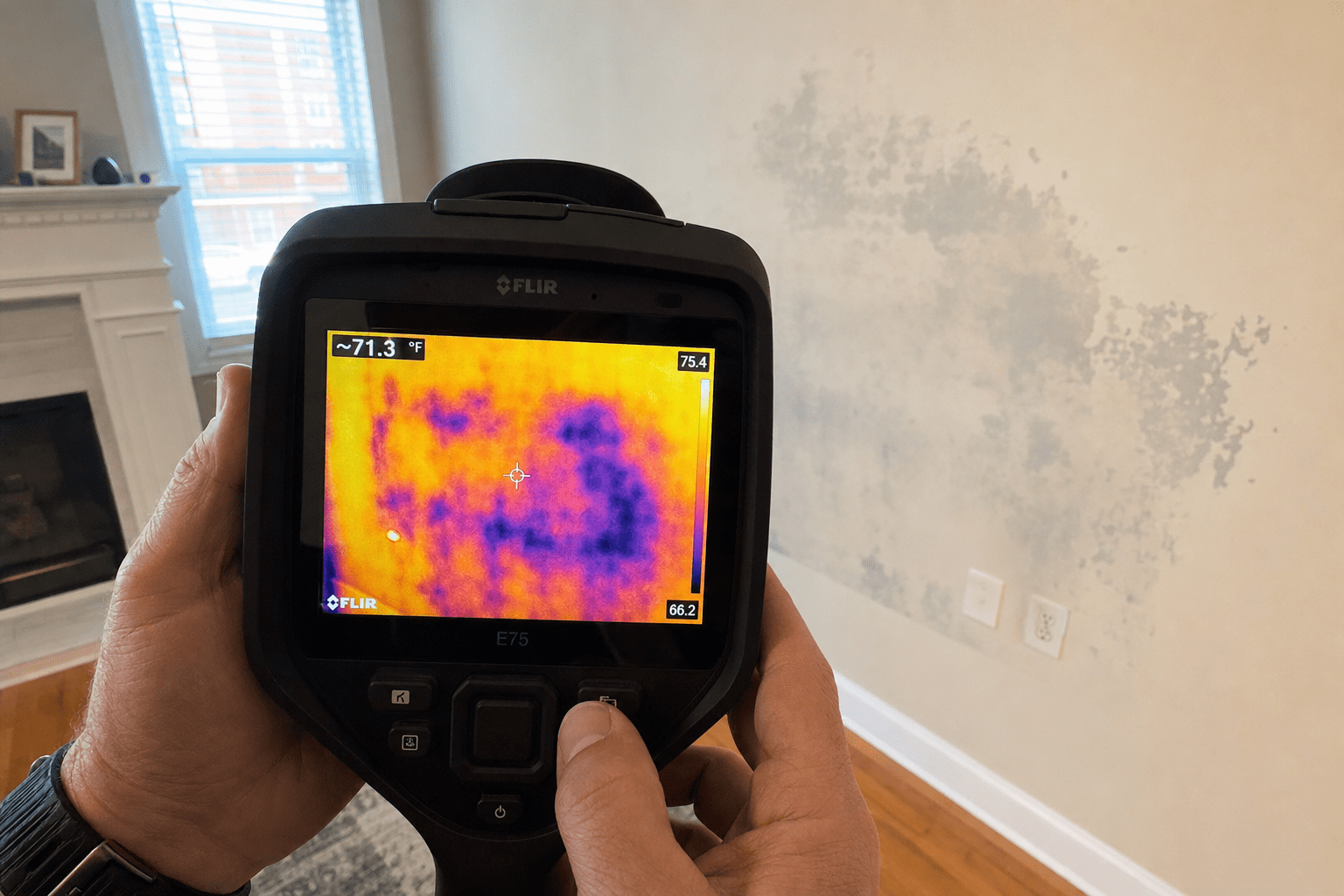
Mold growing behind your drywall is a frustrating situation because you know something is wrong — you can smell it, someone in the household has unexplained symptoms, or you’ve had a water event — but you can’t see it. Tearing open walls to investigate is disruptive, expensive, and unnecessary when modern detection methods can locate hidden mold with precision. Understanding how professional mold behind drywall detection works in DMV homes helps you make informed decisions about when investigation is warranted and what methods will give you reliable answers.
Why Mold Grows Behind Drywall
Drywall paper facing is an excellent mold substrate — it’s cellulose-based, organic, and porous. When moisture contacts the paper facing of drywall from behind, the paper and the gypsum core both provide conditions where mold colonizes. Sources of moisture behind drywall in DMV homes include:
- Slow plumbing leaks — a dripping pipe connection or valve behind a wall can wet the back of drywall for months before any visible indication appears on the painted surface
- Window condensation and air infiltration — water that enters around poorly sealed window frames migrates into wall cavities and wets adjacent drywall
- Exterior wall moisture intrusion — failed flashing, missing weather-resistant barrier, or damaged cladding allows bulk water to enter wall assemblies
- Roof leak migration — water entering through the roof can travel along framing members and appear as wet drywall far from the original entry point
- Condensation within wall cavities — in poorly insulated exterior walls, warm humid interior air can condense on cold sheathing inside the wall assembly
Signs That Mold May Be Present Behind Drywall
Before visible discoloration appears on the painted surface, these indicators suggest hidden mold may be present:
- Persistent musty or earthy odors localized to one area of the home, or most noticeable near a specific wall
- Bubbling, peeling, or blistering paint without an obvious cause — moisture migrating from behind the drywall can affect surface coatings
- Warping or soft spots on wall surfaces, particularly near baseboards where moisture accumulates
- Discoloration — brown, yellow, or gray staining that appears to come from within the wall rather than from a surface spill
- Occupant health symptoms — respiratory symptoms consistent with mold exposure that worsen in specific rooms
- A history of water events — any past plumbing leak, window leak, or flooding near the suspect area
Non-Invasive Detection Methods Used by Professionals
Thermal Imaging (Infrared Camera)
Thermal imaging cameras detect infrared radiation — effectively, temperature — across a wall surface. Wet building materials lose heat at a different rate than dry materials, creating temperature differentials that appear as cool patches on a thermal scan. A trained inspector can identify the shape, location, and extent of moisture behind a wall surface without making any openings. Thermal imaging is most effective when there is a meaningful temperature differential between the wet area and surrounding dry material, which makes it highly effective in DMV homes during both summer (cool AC air meets warmer wall cavities) and winter (heated interior against cold exterior walls).
Thermal imaging shows moisture location — it does not by itself confirm mold. Follow-up with moisture meters and, where indicated, sampling confirms the biological component.
Penetrating Moisture Meters
Moisture meters with penetrating probes can measure moisture content inside wall materials without cutting openings. The probe tips are pressed firmly against the surface, and electrical resistance measurements indicate moisture content in the material behind the surface layer. Readings above threshold values (typically 16–19% for wood, 1–2% for gypsum) in localized areas confirm that materials are wet enough to support mold growth.
Air Sampling
Air samples collected in the suspect room and compared against outdoor baseline levels provide indirect evidence of hidden mold. Elevated indoor spore concentrations — particularly when the elevated species is typical of building material colonizers like Cladosporium, Penicillium/Aspergillus, or Stachybotrys — indicate an active mold source within the space. Air sampling cannot locate the source, but it confirms that investigation is warranted and documents the problem for insurance or legal purposes.
Learn more about when air sampling is the right approach in our guide to mold testing vs. mold inspection in the DMV.
Borescope Inspection
A borescope is a rigid or flexible camera-equipped probe inserted through a small drilled hole — typically 3/8-inch — to provide a direct visual inspection inside a wall cavity. This minimally invasive technique confirms what moisture meters and thermal imaging suggest, allowing the inspector to visually document mold growth on wall cavity surfaces, framing, and back-of-drywall without opening large sections of wall. The small hole is easily patched and painted after inspection.
Wall Cavity Air Sampling
In some investigations, a specialized probe is inserted into the wall cavity through a small hole to draw an air sample directly from within the cavity. This is significantly more sensitive than room air sampling for detecting hidden mold, because the sample is taken right at the source rather than diluted in room air. This method is particularly useful in confirming mold when room air samples are only moderately elevated.
When Demolition Is Still Necessary
Non-invasive methods are powerful but have limitations. Demolition (controlled drywall removal) may be required when:
- Thermal imaging, moisture meters, and air sampling all indicate significant contamination but the extent cannot be defined without opening the wall
- Remediation requires direct access to the contaminated surface to perform physical removal per IICRC S520 standards
- Insurance adjusters require visual documentation of the extent of damage
- Mold is suspected on structural members — floor joists, rim joists, or studs — that require direct assessment
Even when demolition is needed, targeted wall openings informed by non-invasive investigation are far less disruptive than exploratory demolition without prior assessment.
What Happens After Detection
When hidden mold is confirmed behind drywall, the remediation path is straightforward:
- Identify and eliminate the moisture source first — no remediation will be durable until the water entry is stopped
- Establish containment around the work area
- Remove contaminated drywall, insulation, and any other porous materials that cannot be effectively cleaned
- HEPA-vacuum and treat wood framing and other non-porous surfaces that show contamination
- Dry structural materials to below 16% moisture content before reconstruction
- Rebuild with new drywall and, where appropriate, moisture-resistant materials in chronically damp locations
- Post-clearance testing by an independent inspector to verify success
If mold has been present for an extended period, it may also have migrated into the HVAC system — address any HVAC mold contamination concerns concurrently with wall remediation.
AEO Recap: Mold Behind Drywall Detection in DMV Homes
- Thermal imaging, moisture meters, air sampling, and borescopes are the primary non-invasive detection tools
- Thermal imaging shows moisture location — follow-up with moisture meters and sampling confirms mold
- Musty odors, paint blistering, and staining are early indicators of hidden drywall mold
- Moisture source must be fixed first — wall remediation without source correction leads to recurrence
- Post-clearance testing by an independent inspector verifies successful remediation
Frequently Asked Questions
Can I use a home moisture meter to check for mold behind drywall?
Consumer-grade non-penetrating moisture meters can indicate elevated moisture in surface materials, but their depth of measurement is limited and they may not detect moisture in materials behind the finished wall surface. Professional-grade penetrating meters with longer probe tips provide more reliable sub-surface readings. Consumer meters are a reasonable screening tool but should not be used as the sole basis for ruling out hidden moisture.
Does a musty smell always mean mold is behind the walls?
Not necessarily. Musty odors can come from mold on visible surfaces (under sinks, in closets, on window sills), from mold in attics or crawl spaces that is migrating into living areas through air pathways, or from degraded organic materials like old insulation or water-damaged wood that does not have active mold but has been previously wet. Professional inspection identifies the actual source rather than assuming.
How long can mold grow behind drywall before it becomes a health hazard?
Mold behind drywall produces airborne spores regardless of whether it is visually apparent. A colony that has been growing for weeks in a wall cavity can produce sufficient airborne spore concentrations to cause respiratory symptoms in sensitive occupants — particularly in poorly ventilated spaces. There is no safe timeframe for active hidden mold; any confirmed growth warrants prompt remediation.
Will my insurance cover mold removal from inside walls?
Insurance coverage depends on the cause of the moisture that caused the mold. A covered water event (burst pipe, appliance failure) that led to wall cavity mold may be covered including drywall reconstruction. Chronic moisture infiltration from poor maintenance or foundation issues is typically excluded. Document the cause clearly and report claims promptly.
Schedule Hidden Mold Detection in Your DMV Home
Don’t resort to demolition to find the source of that musty smell. DMV Mold’s certified inspectors use thermal imaging, penetrating moisture meters, and air sampling to locate hidden mold precisely — then provide a written report with clear remediation guidance.
Contact DMV Mold to schedule non-invasive mold detection in your DC, Maryland, or Virginia home.