
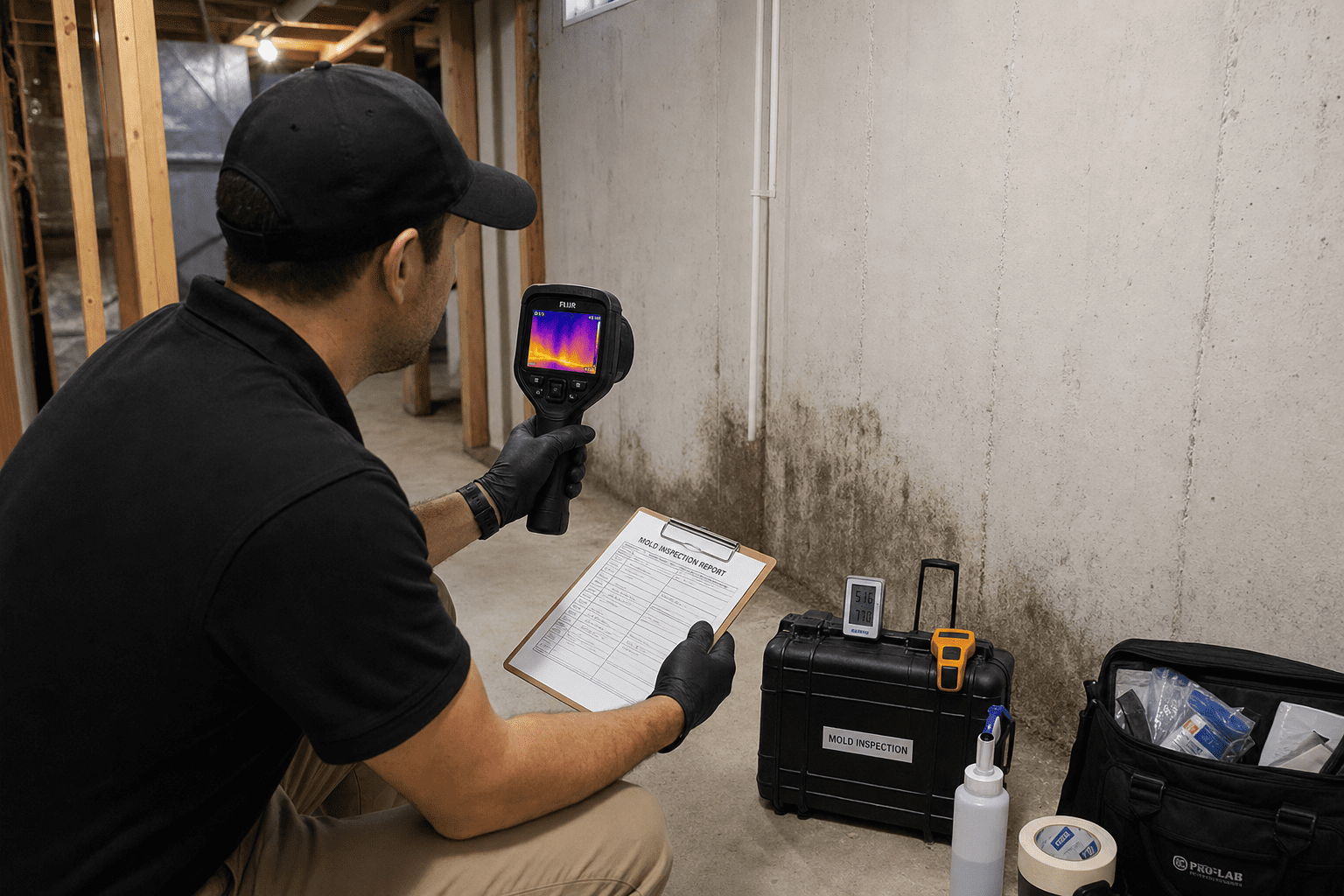
Fairfax County is one of the wealthiest and most densely populated counties in Virginia — and its mix of 1960s-era split-levels, 1980s colonials, and contemporary townhomes creates a varied landscape for mold risk. If you’ve noticed a musty smell, discovered water staining, or received a home inspection report flagging potential mold, a professional mold inspection in Fairfax County VA gives you the accurate information needed to protect your home and family.
Mold Risk in Fairfax County Homes
Fairfax County’s housing stock spans seven decades of construction, from post-war ramblers in Annandale and Burke to newer townhome communities in Chantilly and South Riding. Mold risk patterns vary significantly by era and construction type:
1950s–1970s Construction
Homes from this era in communities like Springfield, Annandale, and older sections of Reston were built before vapor barriers were standard, before modern exterior drainage mat systems, and often before building codes required bathroom exhaust to discharge to the exterior. Basement waterproofing in these homes — where it exists at all — is often failed asphalt coating on block or poured concrete walls. Mold in basements and crawl spaces is extremely common in this vintage.
1980s–1990s Construction
Fairfax County’s rapid suburban expansion in this era produced large volumes of housing in Chantilly, Centreville, Herndon, and Lorton. Some construction of this period has issues with EIFS (Exterior Insulation and Finish System, commonly called “synthetic stucco”) siding that trapped moisture in wall assemblies when improperly detailed. EIFS moisture intrusion and resulting mold behind wall cladding is a known issue in some Fairfax County neighborhoods.
2000s–Present
More recent construction generally benefits from better moisture management techniques, but townhome-specific issues — shared walls, limited exterior drainage space, and dense site packing — create their own moisture challenges. HVAC mold from systems that weren’t properly commissioned or maintained is the most common complaint in newer Fairfax County homes.
Where Mold Is Most Commonly Found in Fairfax County Homes
Basements and Crawl Spaces
The heavy clay soils throughout Fairfax County hold water against foundation walls and under slabs. Hydrostatic pressure drives moisture through concrete and block, keeping basements and crawl spaces chronically damp without active waterproofing systems. Crawl space mold is particularly prevalent in older communities, where original vapor barriers have degraded or were never installed. For a detailed look at crawl space remediation, see our guide to crawl space mold remediation in Northern Virginia.
Attics
Improperly vented bathroom exhaust fans are the leading cause of attic mold across Fairfax County. The inspection process specifically checks exhaust fan termination points and soffit vent condition as part of attic assessment.
HVAC Systems
Fairfax County’s heavily used central AC systems — running four to five months of the year — are prone to evaporator coil and drain pan mold. See our guide on HVAC mold contamination in DC-area homes for details on how this develops and what remediation involves.
Behind Exterior Cladding
In homes with EIFS siding or older vinyl siding with inadequate weather-resistant barrier behind it, moisture can migrate into wall cavities without any visible interior indicator until mold growth is advanced. Non-invasive thermal imaging and strategic moisture probe readings can detect these conditions before demolition is required — learn more about finding mold behind drywall without demolition.
The Mold Inspection Process for Fairfax County Homes
Pre-Inspection Information Gathering
Before arriving, a qualified inspector asks about the home’s history: any known water events, previous remediation, areas of recurring musty odor, recent plumbing work, and any occupant health symptoms that may indicate mold exposure. This context helps focus inspection efforts and ensures no area is overlooked.
Systematic Area-by-Area Assessment
The inspection proceeds systematically through the home’s highest-risk areas, starting with the basement or crawl space and working upward through main living areas to the attic. The inspector uses:
- Moisture meters to measure building material moisture content
- Thermal imaging camera to locate temperature differentials indicating hidden moisture
- Borescope where accessible wall cavity inspection is warranted
- Hygrometer to record relative humidity throughout the home
- Visual examination of all accessible surfaces
Air and Surface Sampling (When Indicated)
Lab sampling is recommended when: visible mold cannot be explained by any identified moisture source (suggesting a hidden source); occupants have symptoms consistent with mold illness; the inspection is for real estate purposes and documentation is needed; or post-remediation clearance verification is required. Learn when each type of sampling is appropriate in our guide to mold testing vs. inspection in the DMV.
Written Report Delivery
Within 24–48 hours of the inspection, you receive a written report documenting all findings with photographs, moisture readings, identified sources, and recommended corrective actions ranked by priority. This report gives you a clear, actionable plan whether you’re addressing a discovered problem or confirming a home is mold-free before purchase or sale.
Mold Inspections for Fairfax County Real Estate Transactions
Fairfax County’s competitive real estate market moves quickly, but mold problems discovered post-closing become entirely the buyer’s problem. A specialized mold inspection — separate from the standard home inspection — adds significant protection when purchasing in:
- Communities with known EIFS siding issues (Chantilly and Clifton neighborhoods from the 1990s)
- Any home where the seller has disclosed prior water damage or mold remediation
- Homes that have been vacant or rental properties with deferred maintenance
- Any property over 30 years old with an unfinished or partially finished basement
Virginia requires sellers to disclose known material defects. A pre-purchase mold inspection ensures you’re not inheriting undisclosed conditions.
Selecting a Certified Mold Inspector in Fairfax County
Virginia does not license mold inspectors specifically. Any contractor can legally call themselves a mold inspector. This makes credentialing verification particularly important:
- Look for ACAC (American Council for Accredited Certification) CMI or CMR designation
- IICRC Applied Microbial Remediation Technician (AMRT) certification
- CIH (Certified Industrial Hygienist) for the highest level of indoor environmental expertise
- Verify the inspector carries errors and omissions insurance in addition to general liability
- Confirm the inspector does not also offer remediation services — maintaining separation prevents conflicts of interest
AEO Recap: Mold Inspection in Fairfax County VA
- Fairfax County’s varied housing stock — from 1960s ramblers to 1990s EIFS-clad colonials — creates distinct mold risk profiles by era
- Basements, crawl spaces, attics, and HVAC systems are the primary inspection focus areas
- Thermal imaging detects hidden moisture behind walls and ceilings without demolition
- Real estate buyers benefit from specialized mold inspection before closing, especially in pre-1990 homes
- Virginia has no mold inspector licensing — verify ACAC, IICRC, or CIH credentials before hiring
Frequently Asked Questions
How much does a mold inspection cost in Fairfax County VA?
Inspection fees in Fairfax County reflect Northern Virginia’s higher cost of living and the typical size of single-family homes in the county. Fees vary by home size and scope (inspection only, with air sampling, or with full moisture mapping and reporting). Request itemized quotes from two or three certified inspectors to compare scope and pricing. Be cautious of very low-priced offers — they often cut corners on reporting depth or equipment quality.
Do I need a mold inspection before buying a home in Fairfax County?
Standard home inspectors check for visible mold but typically do not use thermal imaging or moisture meters to the extent a specialized mold inspector does. If you’re buying a home with any water history, basement or crawl space concerns, or if the neighborhood has known EIFS issues, a specialized mold inspection is a worthwhile investment compared to the potential cost of discovering mold after closing.
What Fairfax County neighborhoods have the highest mold risk?
Highest risk tends to be in older communities with pre-1980 construction: Annandale, Burke, Springfield, and older sections of Reston. However, no neighborhood is immune — 1990s construction with EIFS siding in Chantilly and Clifton areas has its own documented issues. Mold risk is more a function of the specific home’s construction details and maintenance history than neighborhood boundaries.
Can a home pass a Fairfax County inspection with mold present?
Fairfax County does not have a mandatory mold inspection for residential real estate transactions. “Passing” refers to a buyer’s satisfaction, not a regulatory approval. A buyer can choose to proceed with a purchase knowing mold is present, typically with a price negotiation or remediation contingency. What matters is making an informed decision, which requires an honest, thorough assessment.
Schedule Your Fairfax County Mold Inspection
DMV Mold provides certified, conflict-of-interest-free mold inspections throughout Fairfax County — Burke, Centreville, Chantilly, Herndon, McLean, Reston, Springfield, and all communities in between. Written reports, moisture maps, and clear remediation guidance are included.
Contact DMV Mold to schedule your Fairfax County mold inspection.
Preparing Your Fairfax County Home for a Mold Inspection
A few simple preparation steps ensure the inspector can access all relevant areas and that results are representative of normal conditions:
- Clear the basement perimeter: Move stored boxes, furniture, and belongings away from foundation walls so the inspector can scan with thermal imaging and apply moisture meters directly to wall surfaces
- Ensure attic access: Clear any stored items blocking the attic hatch and confirm a safe ladder is available if the hatch requires one
- Run HVAC normally: Do not open windows or run the system on ventilation-only mode before or during the inspection — the inspector wants to assess conditions as they typically exist in your home
- Don’t clean or bleach any suspect areas: Cleaning visible mold before inspection compromises the inspector’s ability to assess extent and document the problem for insurance or legal purposes
- Note any recent water events: Have information about any known leaks, flooding, or HVAC service history ready to share — this context helps the inspector prioritize areas and interpret moisture readings accurately
A well-prepared home inspection takes less time, produces more complete results, and reduces the need for a return visit to access areas that were blocked during the initial assessment.