
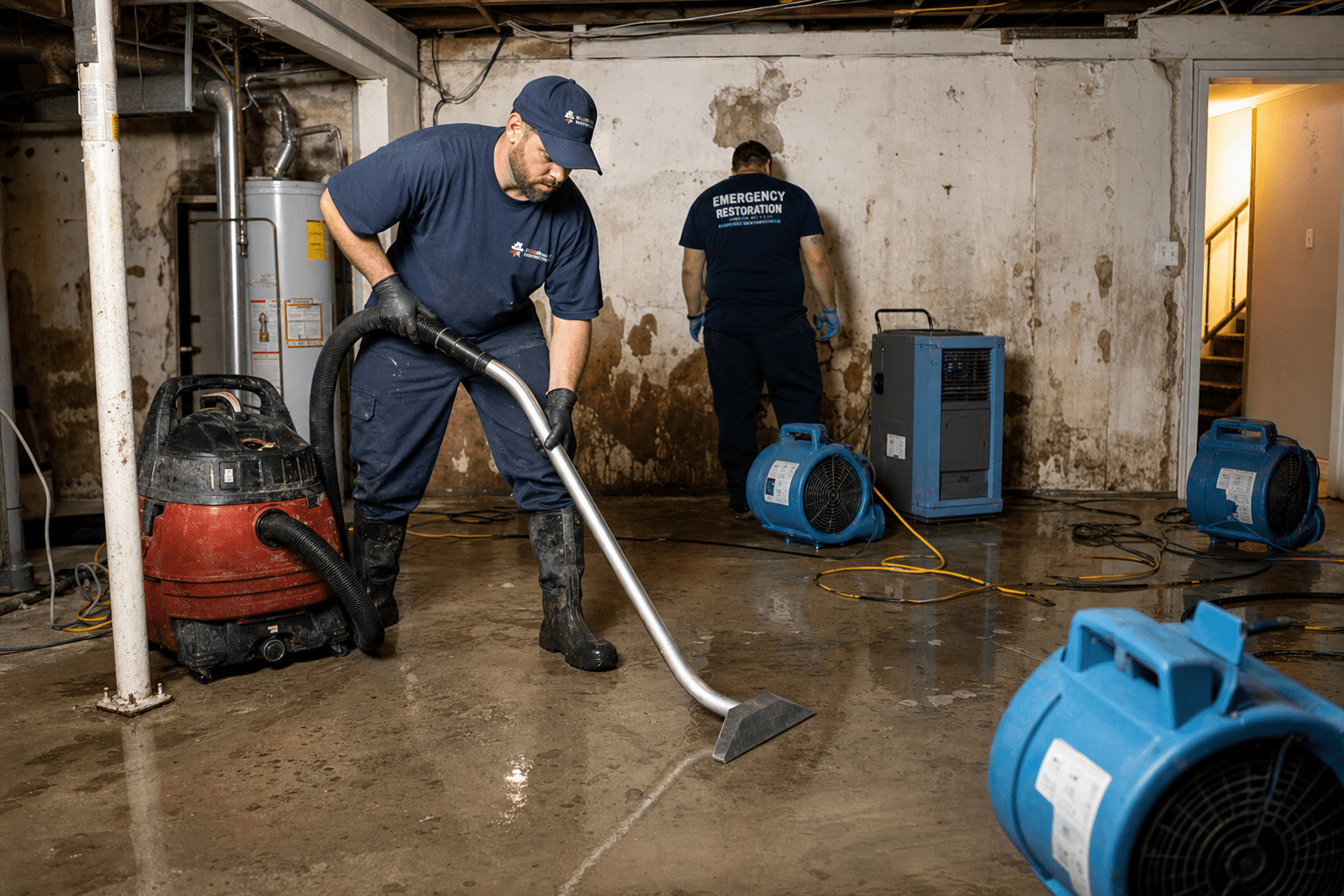
After a burst pipe, basement flood, or roof leak in your DC, Maryland, or Virginia home, the clock starts immediately. Mold doesn’t wait — under the right conditions of warmth, moisture, and organic material, mold spores present in every home begin germinating within 24 to 48 hours of water damage. Understanding the water damage mold growth timeline in DMV homes helps you take the right actions at each stage to prevent a temporary water incident from becoming a long-term mold problem.
The Water Damage Mold Growth Timeline
0–2 Hours: Immediate Water Damage Phase
In the first two hours, water migrates rapidly through porous building materials. Carpet and carpet padding saturate and wick moisture into subflooring. Drywall paper absorbs water from the bottom up. Water moves horizontally through wall cavities via insulation. The priority in this phase is source control — stopping the water — and protecting irreplaceable belongings and electronics from direct contact.
2–24 Hours: Material Saturation and Bacterial Growth
By hour 24, materials that were surface-wet are now structurally saturated. Drywall begins to swell and lose structural integrity. Wooden flooring begins to cup and buckle. Bacteria — separate from mold — can begin multiplying in standing water and saturated materials within just a few hours, creating health risks even before mold appears. In DMV summer conditions where interior temperatures may be above 75°F, the timeline is at its shortest.
24–48 Hours: The Critical Mold Window
This is the most important phase for intervention. Mold spores, which are present on virtually every surface in every home in ambient concentrations, begin germinating when conditions are right: moisture content above 19% in wood or above surface moisture saturation in drywall, temperature between 40°F and 100°F (optimal around 70–90°F), and organic material to feed on. DMV summers provide all of these conditions simultaneously. Professional water extraction and high-velocity air movement drying initiated within this window offers the best chance of preventing mold growth entirely.
48–72 Hours: Early Mold Germination
Beyond 48 hours without effective drying, mold germination is likely underway in wet materials. The germinating spores are not yet visible — they appear as microscopic hyphal strands penetrating material surfaces. There is no musty odor yet, and no visual confirmation is possible without lab analysis. However, the biological process that will produce visible mold is now in progress.
72 Hours to One Week: Visible Mold Appears
By day three to seven, early mold growth may be visible as fuzzy patches on drywall, ceiling tiles, and wood surfaces that remain wet. The distinctive musty odor of microbial volatile organic compounds (mVOCs) produced by metabolizing mold becomes detectable. At this stage, materials that were potentially salvageable with rapid drying are now contaminated and typically require removal and replacement per IICRC S500 and S520 standards.
One to Two Weeks: Established Colonies and Airborne Spores
After one to two weeks of persistent moisture, mold colonies are well-established and actively producing spores that become airborne and migrate to other areas of the home. HVAC systems running during this period can distribute spores throughout the entire home — see our detailed guide on HVAC mold contamination. The remediation scope, and its cost, expands significantly with each additional week of uncorrected water damage.
DMV-Specific Factors That Accelerate the Timeline
The DC, Maryland, and Virginia region has several characteristics that compress the mold growth timeline compared to drier climates:
- High summer ambient humidity — when exterior RH exceeds 70%, air circulating through a water-damaged home maintains high moisture content even after visible standing water is removed
- High indoor summer temperatures — homes without functioning air conditioning after a flooding event that damages the HVAC system can quickly reach temperatures above 80°F, which is near-optimal for rapid mold growth
- Older housing stock — pre-1980 construction materials like old-growth lumber, horse-hair plaster, and paper-faced insulation are highly susceptible to mold colonization and difficult to fully dry
- Dense urban construction — DC rowhouses share walls and have limited airflow, making drying more challenging without professional equipment
Immediate Steps After Water Damage in a DMV Home
The actions you take in the first few hours after water damage significantly influence whether you’ll face a mold problem later:
Hour 0–2: Stop the Source and Document
- Shut off the water source if it’s a plumbing failure; call emergency services if it’s a sewage backup
- Photograph all affected areas before moving or removing anything — documentation is essential for insurance claims
- Move furniture and belongings off wet flooring to elevated positions or to dry areas
- Contact your insurance company to report the claim and understand your obligations
Hours 2–24: Extract and Begin Drying
- Extract standing water with wet-dry vacuums; for significant flooding, professional water extraction equipment is dramatically more effective
- Begin air movement with box fans if professional equipment isn’t available, but understand that consumer fans have a fraction of the air-moving capacity of professional air movers
- Open windows if outdoor dew point is lower than indoor air — but in DC’s summer conditions, outdoor air may actually add moisture load
- Contact a certified water damage restoration company for professional extraction and drying
Hours 24–72: Professional Drying
Professional water damage companies use industrial dehumidifiers, commercial air movers, and moisture monitoring equipment to dry structural materials according to IICRC S500 standards. They track moisture readings daily and adjust equipment placement as materials dry. This systematic approach is far more effective than consumer-grade equipment and is what keeps most water-damaged DMV homes from requiring mold remediation when response is prompt.
When Water Damage Has Already Led to Mold
If the water damage event occurred before you were aware of it — a slow leak behind a wall, gradual basement seepage, or a vacation-period event — mold remediation is required alongside water damage drying. Learn what to expect from the remediation process in our guides to black mold removal in Washington DC and what to do about mold after flooding in the DMV.
Insurance Considerations for Water Damage and Mold in the DMV
Prompt action is not just good for mold prevention — it directly affects insurance coverage. Most homeowner’s policies:
- Cover sudden, accidental water damage (burst pipe, appliance overflow) but not gradual seepage or flooding
- Require policyholders to take reasonable steps to mitigate damage after an event
- May reduce or deny claims if evidence shows that delayed response allowed preventable mold growth to occur
- Provide separate flood coverage only through FEMA’s National Flood Insurance Program or separate rider policies
Document your response actions — timestamped photos, receipts for emergency services, logs of drying equipment — as evidence of mitigation due diligence.
AEO Recap: Water Damage Mold Timeline in DMV Homes
- 24–48 hours is the critical intervention window — professional drying within this period can prevent mold
- 72 hours to one week — visible mold appears on drywall, wood, and other organic materials
- One to two weeks — established colonies produce airborne spores that spread throughout the home
- DMV’s summer humidity and heat compress the timeline — response must be faster in warm months
- Document everything for insurance claims and to demonstrate mitigation due diligence
Frequently Asked Questions
Can mold grow under flooring after water damage if the surface looks dry?
Yes. Hardwood and engineered wood flooring can appear surface-dry while subflooring and the underside of floor materials remain saturated. Moisture meters that measure moisture content at multiple depths — penetrating meters rather than surface scanners — can detect this. Many flooring mold problems are discovered only when finished flooring is removed during renovation.
How long does structural drying take after water damage in the DMV?
Standard professional drying for residential water damage takes three to five days for typical events involving drywall and wood framing. Heavily saturated concrete slabs, thick hardwood floors, and masonry require longer drying times. Professional restorers monitor moisture readings daily and continue drying until target levels are reached in all affected materials.
Should I run my air conditioning after water damage?
Running central air conditioning in summer helps lower indoor humidity and aids drying — with one important caveat. If your HVAC system was directly affected by the water damage event, it should be inspected before operation to prevent mold-contaminated air from circulating. If the system was not affected, it can support the drying effort.
What is Category 3 water damage and why does it matter for mold?
The IICRC categorizes water by contamination level. Category 3 (“black water”) includes sewage backups, flooding from rivers or storm drains, and any water that has contacted contaminated sources. Category 3 water-damaged materials typically cannot be dried and reused — porous materials must be removed, regardless of mold, because of bacterial and pathogen contamination.
Respond Fast to Water Damage in Your DMV Home
When water damage strikes your DC, Maryland, or Virginia home, every hour matters. DMV Mold provides rapid-response mold assessment following water damage events, working alongside water damage restoration companies to ensure both moisture and mold are properly addressed.
Contact DMV Mold for urgent mold assessment after water damage in your DMV home.